


How Flooring Choices Affect Performance, Aesthetics and Longevity: Part 2
Material Options and What They Actually Offer
Vulcanised Rubber
Vulcanised rubber is the workhorse of the industry and for good reason. It is durable, shock-absorbent, resistant to equipment indentation and available in a quality range that spans from the basic to the genuinely refined. At the upper end, dense, precision-cut tiles or rolls in deep blacks and carefully considered colours, act as a deliberate material rather than a default one.
Hardwood and Engineered Hardwood
Hardwood and engineered hardwood bring a warmth and visual quality that rubber cannot replicate. They are underused in gym environments because of a persistent belief that they cannot stand up to the demands of training. In practice, a correctly specified and properly installed hardwood floor will perform well across most training disciplines, with the exception of heavy Olympic lifting, where a dedicated platform makes more sense than asking the entire floor to absorb that particular load.
Luxury Vinyl
Luxury vinyl and composite surfaces have matured considerably in recent years. The best products combine exceptional durability with a visual quality that closely mimics natural materials. Their installation flexibility (floating, glued, or loose-lay), depending on the subfloor condition, makes them practical for refurbishment projects where the subfloor cannot be disturbed.
Poured and Polished Surfaces
Poured and polished surfaces, such as epoxy, polyurethane or microcement, offer a seamless, architecturally coherent result that suits certain aesthetic briefs extremely well. They require careful specification to achieve the right balance of hardness and resilience, and they reward investment in surface preparation.
Zone Thinking
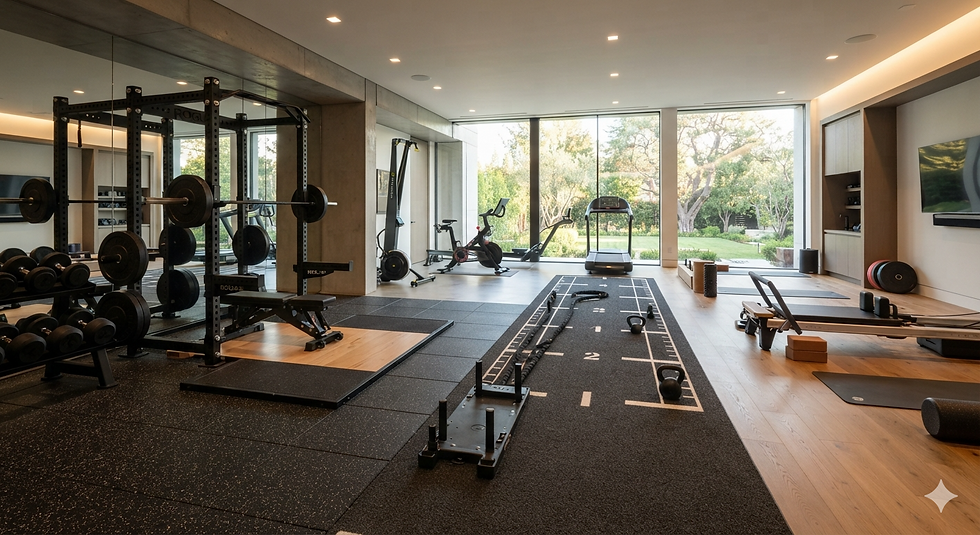
The most considered gym floors are composed of different materials serving different zones, tied together by a coherent design.
A luxury home gym might use engineered oak across the central training floor, transitioning to dense rubber within a defined lifting platform, with a microcement finish continuing through into the adjacent shower and changing area. Each material is doing the work it is best suited for and the transitions between them become design details in their own right rather than awkward junctions to be concealed.
This zoned approach requires the flooring to be finalised during space planning - another reason why the best results come from considering the design of a gym environment as an integrated project, rather than a sequence of separate decisions.
The Subfloor Question
No surface specification can outperform the subfloor beneath it. Existing concrete that is uneven, damp-affected, or structurally compromised will compromise any finish applied over it, regardless of quality. For older London properties, basements that have been converted, mews houses with original floor structures, a proper assessment of the subfloor condition before planning is a prerequisite.
In new-build projects, the opportunity to design from the ground up produces results that refurbishment projects struggle to match.
The flooring choice for a gym is not a decision that should be made from a catalogue. It benefits from being made in context, with an understanding of how the space will be used, what it sits within and what it should feel like to train there. Getting this right from the outset avoids the significant cost and disruption of doing it twice.
Comments